There was horror in some musical circles as a guitarist from a boy band performed on stage with an all-male chamber choir at a televised talent competition on Saturday night.
Guitarist Ronnie Wood is a member of boy band The Rolling Stones, which underwent several line-up changes in its early days but has had the same four members since 1993. Their first manger, Andrew Loog Oldham, carefully manufactured the boy band’s image, even changing their name (originally, the band were known as The Rollin’ Stones, but Oldham felt this would be less memorable for the record-buying public), demoting their then-keyboardist Ian Stewart to studio play only as he felt Stewart’s ‘look’ didn’t fit well with the band, and deliberately positioning them as a ‘bad boy’ alternative to the other well-known boy band of the time, The Beatles, who had a more clean cut and wholesome image. The Rolling Stones eventually managed to shake off the kind of controlling management often given to such boy bands, though not before their second manager, impresario Allen Klein, duped the group of young men into signing over the rights to most of their previous songs. The Rolling Stones still have a large following and older fans are still known for comparing themselves favourably to fans of The Beatles, despite the fact the rivalry between the two boy bands was largely manufactured.
One Direction are an all-male chamber choir with five members, specialising in vocal harmonies and part-singing. Group member Harry Styles decided on the group’s name, which fans often abbreviate to 1D. They write many of their own songs with contributions from other well-known, successful songwriters. Band members also include Louis Tomlinson, a successful performer in a variety of musicals before he joined the group, Niall Horan, who in addition to much previous choir experience is also a talented guitarist, Zayn Malik, who has also learned to dance since joining the group, and Liam Payne, also known for his remixing work.
1D’s genre-fusing performance with Wood managed to bring together two worlds often seen as poles apart; the manufactured boy band, and what twitter has hashtagged “#realmusic”.
[Some facts may have been deliberately misconstrued and definitely a bit twisted in order to make a lighthearted point about musical snobbery.]

Showing posts with label Writing. Show all posts
Showing posts with label Writing. Show all posts
Tuesday, 16 December 2014

Monday, 1 September 2014
In autumn, a young* woman's fancy lightly turns to thoughts oftrip-hop... and more - Ruth
Oh, spring and summer are such wonderful seasons for discovering new music. Watching the first leaves appear on the trees and wanting a soundtrack for all this new growth. Going to a festival, chancing to walk past a stage with a band playing who suddenly become my new favourite musicians EVER…
But in autumn, I want the familiar around me. Return to routine (kid back in school), return to old, warm cardigans, return to musical favourites. Autumn’s also - for me - a time for albums. A time to put the record player on and listen from start to finish whilst sewing on the school name labels, lost in a reverie of sound.
Some of my favourite autumn albums I’ve listened to pretty much every single autumn since my youth; one or two are slightly more recent finds, but in no particular order, here are my top five “albums to which I return every autumn”.
1. Tricky: Maxinquaye.
This is a gorgeous album; Martina Topley-Bird’s lush vocals combine with Tricky’s inventive sounds to create something really special, which to my mind at least hasn’t really dated, either. The piano at the end of Ponderosa (the track above) is one of my favourite things ever.
If you like this you might also like: Hello, by Poe.
2. The Mediaeval Baebes: Salva Nos
I remember when this album came out I thought, “where have you BEEN all my life?!” The Baebes are one of our influences, and we’ve even covered the song above (a more stripped down verson). This album is perfect for the later end of autumn, as it gets colder and frosty and starts to turn to winter.
If you like this you might also like: Madra, by Miranda Sex Garden (one of their early albums, full of madrigals).
3. Enya: The Celts
Yes, I know Enya isn’t “cool”. I don’t give a fig. I unashamedly adore this album. It’s imaginative, it’s faerytale-esque, and yes, it’s synthtastic. What’s not to love? This was one of the first CDs I ever bought, too (as prior to the early nineties I had everything on tape)! Also, the wonderful Uke of Carl has a ukulele tab for Enya’s Orinoco Flow, which I’ve certainly played at people quite a bit.
If you like this, you might also like: An Ancient Muse, by Loreena McKennitt (people often compare her to Enya, but I think she’s a LOT more folky).
4. Portishead: Portishead
I remember walking across the St. Kev’s field (as was - it’s now a housing estate) to get from my home to Kirkby station in order to get into Liverpool, with this playing on my walkman. (I’m really sorry, Portishead, but it wasn’t even a tape I’d bought; one of my bezzies had taped it for me. I have paid for your music since, though, so … forgive me?) Nothing quite so redolent of the end of summer as walking over an empty landscape with trees fast becoming bare, listening to this.
If you like this you might like: Beth Orton, Trailer Park (they’re actually not that similar stylistically, but there’s something about the magical bleakness of Trailer Park that I find very similar, atmospherically speaking, to Portishead. Also, for a brief while in my youth I confused Beth Ortion with Beth Gibbons, Portishead’s singer).
5. The Magic Theatre: London Town
A more recent addition to my autumnal mix this. This came out in 2010 but for some reason (WHY DID NONE OF YOU TELL ME SOONER?!) I only got around to buying it in the autumn of 2011. And then I played it endlessly. An album about a man from the sixties time travelling to the Victorian era and falling in love… what’s not to like? It holds a special place in my heart too, because during that autumn, I met Marc (the man who puts the “Jones” in “Moss & Jones”) and this music brings back memories of our first dates together. Though I hope our relationship doesn’t end with him going back to his own time zone.
If you like this you might also like: The Long Way Home, by The Magic Theatre.
They’re my top five return to autumn albums (although honourable mention must also go to the Moulettes’ self-titled album, Miles Davis’ Kind of Blue, The Streets’ Original Pirate Material and Mono’s Formica Blues). What are yours?
* I’m using “young” in a really loose sense. The other day I couldn’t remember if I was 37 or 38.
But in autumn, I want the familiar around me. Return to routine (kid back in school), return to old, warm cardigans, return to musical favourites. Autumn’s also - for me - a time for albums. A time to put the record player on and listen from start to finish whilst sewing on the school name labels, lost in a reverie of sound.
Some of my favourite autumn albums I’ve listened to pretty much every single autumn since my youth; one or two are slightly more recent finds, but in no particular order, here are my top five “albums to which I return every autumn”.
1. Tricky: Maxinquaye.
This is a gorgeous album; Martina Topley-Bird’s lush vocals combine with Tricky’s inventive sounds to create something really special, which to my mind at least hasn’t really dated, either. The piano at the end of Ponderosa (the track above) is one of my favourite things ever.
If you like this you might also like: Hello, by Poe.
2. The Mediaeval Baebes: Salva Nos
I remember when this album came out I thought, “where have you BEEN all my life?!” The Baebes are one of our influences, and we’ve even covered the song above (a more stripped down verson). This album is perfect for the later end of autumn, as it gets colder and frosty and starts to turn to winter.
If you like this you might also like: Madra, by Miranda Sex Garden (one of their early albums, full of madrigals).
3. Enya: The Celts
Yes, I know Enya isn’t “cool”. I don’t give a fig. I unashamedly adore this album. It’s imaginative, it’s faerytale-esque, and yes, it’s synthtastic. What’s not to love? This was one of the first CDs I ever bought, too (as prior to the early nineties I had everything on tape)! Also, the wonderful Uke of Carl has a ukulele tab for Enya’s Orinoco Flow, which I’ve certainly played at people quite a bit.
If you like this, you might also like: An Ancient Muse, by Loreena McKennitt (people often compare her to Enya, but I think she’s a LOT more folky).
4. Portishead: Portishead
I remember walking across the St. Kev’s field (as was - it’s now a housing estate) to get from my home to Kirkby station in order to get into Liverpool, with this playing on my walkman. (I’m really sorry, Portishead, but it wasn’t even a tape I’d bought; one of my bezzies had taped it for me. I have paid for your music since, though, so … forgive me?) Nothing quite so redolent of the end of summer as walking over an empty landscape with trees fast becoming bare, listening to this.
If you like this you might like: Beth Orton, Trailer Park (they’re actually not that similar stylistically, but there’s something about the magical bleakness of Trailer Park that I find very similar, atmospherically speaking, to Portishead. Also, for a brief while in my youth I confused Beth Ortion with Beth Gibbons, Portishead’s singer).
5. The Magic Theatre: London Town
A more recent addition to my autumnal mix this. This came out in 2010 but for some reason (WHY DID NONE OF YOU TELL ME SOONER?!) I only got around to buying it in the autumn of 2011. And then I played it endlessly. An album about a man from the sixties time travelling to the Victorian era and falling in love… what’s not to like? It holds a special place in my heart too, because during that autumn, I met Marc (the man who puts the “Jones” in “Moss & Jones”) and this music brings back memories of our first dates together. Though I hope our relationship doesn’t end with him going back to his own time zone.
If you like this you might also like: The Long Way Home, by The Magic Theatre.
They’re my top five return to autumn albums (although honourable mention must also go to the Moulettes’ self-titled album, Miles Davis’ Kind of Blue, The Streets’ Original Pirate Material and Mono’s Formica Blues). What are yours?
* I’m using “young” in a really loose sense. The other day I couldn’t remember if I was 37 or 38.
Tuesday, 26 August 2014
In defence of open mic nights, by Ruth
I’ve read a few blog posts recently knocking open mic nights, primarily from the usual “don’t play for free” standpoint that gets hashed and rehashed and then mashed and bathed in oil and fried and re-hashed again over on many music forums (including the wonderful Liverpool Bands).
Now, the “don’t play for free” thing is quite an old debate and tends to go like this: “I’ll get a plumber to come over and offer to pay THEM with ‘exposure’ shall I?” “Yes but a plumber has had to take exams and learn how to be a plumber.” “So have I, I did my grade 5 piano when I was 19.” And on, and on. I don’t want particularly to rehash that argument because it never ends. I will say, we’ve played the vast majority of our gigs for free, and we’ve also done a handful where we’ve been paid (though not huge amounts by any stretch).
I am also perfectly aware that it’s different for us, an acoustic duo who practise at home and don’t have massive overheads (although we really should get that piano tuned), than, say, a four or five piece band who have to pay out for rehearsal room hire and sound equipment and so on. But this is about open mic nights, and let’s face it, they’re aimed at small bands and solo acts.
Anyway, the anti- open mic stuff I’ve read seems to be based on the premise that this, too, is playing for free, and given that musicians should apparently Never Ever Do That, it’s also wrong to perform at an open mic.
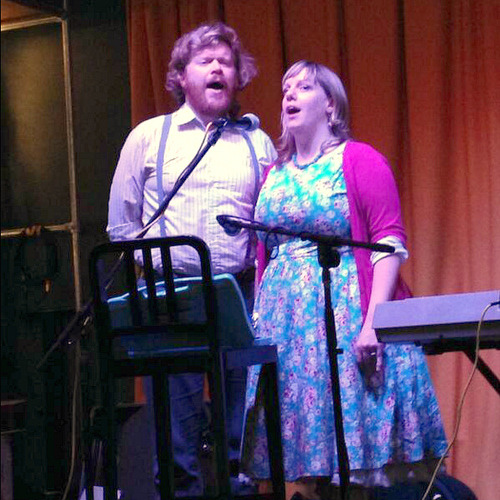
That’s a picture of us, performing at an open mic, by the way, in case you were wondering on which side of this argument we fell.
I really do think that doing a slot at an open mic is different than doing a gig for free. I have some sympathy with the idea that bands shouldn’t do the latter (though, see earlier, we have) but … an open mic? Really?
Let’s take this in two parts.
Firstly, the idea which I’ve read a bit that landlords are putting on open mic nights to avoid paying to put on a band. Okay, let’s start with the thing about “landlords”. Most open mics I’ve been to have been in cafés or bars. I’ve been to literally one open mic in a proper old school “pub with a landlord” pub, and that was a weird little place in Deptford in 2001, back when I lived in London. Also it was a poetry open mic, which may - or may not - be different.
In fact, I ran an open mic a few years ago in a café in St. Helens. The owner of the café actually opened it up specifically on a Monday evening once a month just for the open mic. I approached him with the idea, not vice versa. He made no money off it on the night, at least at first, as everyone brought their own booze. The only people who came were performers and their friends; there was no passing trade because the café wouldn’t have been open then anyway. If it wasn’t for the open mic, the place would have been closed on a Monday night and it might even have saved him some money on heating and lecky bills. He was a big advocate for the arts, and in the long term, I think having the open night there made people kindly disposed towards the place and more likely to come back. Hardly a cynical landlord putting on an open mic because he was too tight to pay a band.
Also, let’s be brutally honest here. Lots of acts performing at open mics are amazing, but some are … on their way to amazing, and not quite there yet. That’s okay, of course, everyone starts somewhere, but the idea a pub landlord would believe that punters would be just as happy with an open mic as with a booked band is a tad silly, n’est ce pas?
I’ve also met quite a few people running open mics, but never once have I met one whose motives have been about “saving money on bands”. Mostly, they’ve wanted to give new talent a platform, hear new music and have a bit of a ‘jam’. Occasionally they’ve wanted to make a bit of a name for themselves as a compère. Once or twice it’s so they’ve a regular opportunity to perform their own songs/poems. But even the more cynical of those reasons is nothing compared to the suggestion that they want to save money for the venue.
Most of the time, running an open mic is an unpaid task, too. If anyone should get narky about not getting paid, it’s the compère/organiser and not the performers; they’re doing a hugely hard job behind the scenes and on the night and usually on a volunteer basis too, and usually they go largely unthanked (people seem to think the compère is part of the furniture. So I’d like to take this opportunity to thank from the bottom of my heart anyone who has ever ran an open mic event we’ve attended. You’re amazing, you really are). But no one seems to mention them in the anti-open mic stuff.
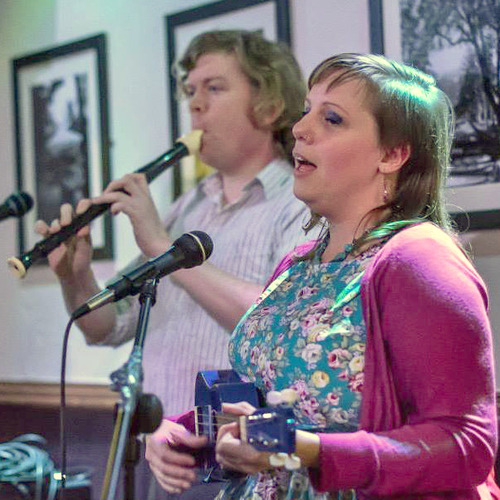
There we are at another open mic night, depriving booked performers of a decent crust. Oh, wait, there were some booked performers that night too, earning a decent crust.
Secondly, the idea that playing an open mic is the same as playing a normal gig, unpaid. It just isn’t! In order to get a gig, you have to - well, I’ll be honest, we haven’t completely figured it out yet. Be lucky, in the right place at the right time, know the right people and work hard. And be really cheeky too, but the right amount of cheeky. But what you CAN’T do, is just turn up and start playing.
Unlike an open mic night.
Time to be totally honest here. We’ve not always been that good. I know, I know, you’re shocked and horrified. But it’s true. When we started out in the winter of 2012 with nothing but a violin and a really cheap ukulele we played the rounds of open mics because we were literally okay. It took us over half a year of playing open mic nights before we could even dream of being good enough to play a full gig. We are SO grateful to those places that put them on and gave us the chance to practice in front of an audience, seeing what worked, and what didn’t, and who put up with our “let’s use a violin to open Hark the Herald, instead of a trumpet, that’ll totally work!”
Let’s face it, too; not all, but some open mic events have some quite sophisticated sound equipment and someone knowledgeable around to work it. If you really can’t shake the idea that you’re somehow being “done” because you’re playing for free, think of it as a barter. You’re getting to hire a PA and a sound engineer for fifteen minutes; they’re getting to hear your unique finger-plucking cover of Shakermaker.
And at those open mic events that are unamplified, which are basically busking without the hat? What does the performer get there? Well, we’ve made friends at these and got talking to other musicians who are at similar stages to us; we’ve shared tips and swapped contacts, and again… you’re getting to practice in front of an audience. Yes, you could do that with busking too (and we plan to) but people are less likely to sit and listen when it’s chucking it down and freezing cold. It’s also fantastic for young musicians (I mean really young, too; I’ve been at an open mic where a ten or eleven year old boy performed a violin solo that would have made Nigel Kennedy’s eyes open wide with amazement) who wouldn’t normally get that kind of platform outside of school assemblies. You’re getting a warm audience, in more than one sense of the word “warm”.
—-
One thing I will say, however, is that the idea that venues and promoters, or even music executives, are scouring the open mics looking for new talent, has certainly not been our experience. I think we’ve got just two gigs from people seeing us at an open mic, and that’s in going on three years of doing them (as I said earlier, we have got our gigs through a mixture of other methods, but rarely this). I think if you’re going around open mics expecting to be noticed and given gigs, or signed, or whatever, you’re possibly approaching it with the wrong idea and it’s going to make you a bit miserable. If, however, you see open mics as a great place to practise playing in front of an audience, and also a wonderful opportunity to be the first of your friends to hear some amazing new music, and of course, to make friends, to have fun, and to do what you love, then you’re probably going to enjoy yourselves.
So, yes, we’ll continue to do open mic events in amongst our gigs. Because we love them. The whole “don’t play gigs for free” thing is another discussion for another time, and with that, I can genuinely see both sides of the debate. But I don’t think open mic events fit into the category of “playing a gig for free”.
And if you want to earn a living from music? Join a covers band and practise every day and do the ultra-competitive world of weddings and pubs. Become a music teacher (hey, all you need to do is increase that grade 5 piano to a grade 8, and then maybe get your ABRSM diploma in music teaching, and sort out your DBS form, and get a customer base and a reputation). Work hard and learn a craft as a sound engineer (because it’s true, no one does ask them to work for “exposure”).
Or become a rock star. I’m not sure how you do that though.
(Other ways of making money within the music industry do exist and all involve lots of hard work and tend not to be impeded by playing, or not, open mic nights.)
Now, the “don’t play for free” thing is quite an old debate and tends to go like this: “I’ll get a plumber to come over and offer to pay THEM with ‘exposure’ shall I?” “Yes but a plumber has had to take exams and learn how to be a plumber.” “So have I, I did my grade 5 piano when I was 19.” And on, and on. I don’t want particularly to rehash that argument because it never ends. I will say, we’ve played the vast majority of our gigs for free, and we’ve also done a handful where we’ve been paid (though not huge amounts by any stretch).
I am also perfectly aware that it’s different for us, an acoustic duo who practise at home and don’t have massive overheads (although we really should get that piano tuned), than, say, a four or five piece band who have to pay out for rehearsal room hire and sound equipment and so on. But this is about open mic nights, and let’s face it, they’re aimed at small bands and solo acts.
Anyway, the anti- open mic stuff I’ve read seems to be based on the premise that this, too, is playing for free, and given that musicians should apparently Never Ever Do That, it’s also wrong to perform at an open mic.
That’s a picture of us, performing at an open mic, by the way, in case you were wondering on which side of this argument we fell.
I really do think that doing a slot at an open mic is different than doing a gig for free. I have some sympathy with the idea that bands shouldn’t do the latter (though, see earlier, we have) but … an open mic? Really?
Let’s take this in two parts.
Firstly, the idea which I’ve read a bit that landlords are putting on open mic nights to avoid paying to put on a band. Okay, let’s start with the thing about “landlords”. Most open mics I’ve been to have been in cafés or bars. I’ve been to literally one open mic in a proper old school “pub with a landlord” pub, and that was a weird little place in Deptford in 2001, back when I lived in London. Also it was a poetry open mic, which may - or may not - be different.
In fact, I ran an open mic a few years ago in a café in St. Helens. The owner of the café actually opened it up specifically on a Monday evening once a month just for the open mic. I approached him with the idea, not vice versa. He made no money off it on the night, at least at first, as everyone brought their own booze. The only people who came were performers and their friends; there was no passing trade because the café wouldn’t have been open then anyway. If it wasn’t for the open mic, the place would have been closed on a Monday night and it might even have saved him some money on heating and lecky bills. He was a big advocate for the arts, and in the long term, I think having the open night there made people kindly disposed towards the place and more likely to come back. Hardly a cynical landlord putting on an open mic because he was too tight to pay a band.
Also, let’s be brutally honest here. Lots of acts performing at open mics are amazing, but some are … on their way to amazing, and not quite there yet. That’s okay, of course, everyone starts somewhere, but the idea a pub landlord would believe that punters would be just as happy with an open mic as with a booked band is a tad silly, n’est ce pas?
I’ve also met quite a few people running open mics, but never once have I met one whose motives have been about “saving money on bands”. Mostly, they’ve wanted to give new talent a platform, hear new music and have a bit of a ‘jam’. Occasionally they’ve wanted to make a bit of a name for themselves as a compère. Once or twice it’s so they’ve a regular opportunity to perform their own songs/poems. But even the more cynical of those reasons is nothing compared to the suggestion that they want to save money for the venue.
Most of the time, running an open mic is an unpaid task, too. If anyone should get narky about not getting paid, it’s the compère/organiser and not the performers; they’re doing a hugely hard job behind the scenes and on the night and usually on a volunteer basis too, and usually they go largely unthanked (people seem to think the compère is part of the furniture. So I’d like to take this opportunity to thank from the bottom of my heart anyone who has ever ran an open mic event we’ve attended. You’re amazing, you really are). But no one seems to mention them in the anti-open mic stuff.
There we are at another open mic night, depriving booked performers of a decent crust. Oh, wait, there were some booked performers that night too, earning a decent crust.
Secondly, the idea that playing an open mic is the same as playing a normal gig, unpaid. It just isn’t! In order to get a gig, you have to - well, I’ll be honest, we haven’t completely figured it out yet. Be lucky, in the right place at the right time, know the right people and work hard. And be really cheeky too, but the right amount of cheeky. But what you CAN’T do, is just turn up and start playing.
Unlike an open mic night.
Time to be totally honest here. We’ve not always been that good. I know, I know, you’re shocked and horrified. But it’s true. When we started out in the winter of 2012 with nothing but a violin and a really cheap ukulele we played the rounds of open mics because we were literally okay. It took us over half a year of playing open mic nights before we could even dream of being good enough to play a full gig. We are SO grateful to those places that put them on and gave us the chance to practice in front of an audience, seeing what worked, and what didn’t, and who put up with our “let’s use a violin to open Hark the Herald, instead of a trumpet, that’ll totally work!”
Let’s face it, too; not all, but some open mic events have some quite sophisticated sound equipment and someone knowledgeable around to work it. If you really can’t shake the idea that you’re somehow being “done” because you’re playing for free, think of it as a barter. You’re getting to hire a PA and a sound engineer for fifteen minutes; they’re getting to hear your unique finger-plucking cover of Shakermaker.
And at those open mic events that are unamplified, which are basically busking without the hat? What does the performer get there? Well, we’ve made friends at these and got talking to other musicians who are at similar stages to us; we’ve shared tips and swapped contacts, and again… you’re getting to practice in front of an audience. Yes, you could do that with busking too (and we plan to) but people are less likely to sit and listen when it’s chucking it down and freezing cold. It’s also fantastic for young musicians (I mean really young, too; I’ve been at an open mic where a ten or eleven year old boy performed a violin solo that would have made Nigel Kennedy’s eyes open wide with amazement) who wouldn’t normally get that kind of platform outside of school assemblies. You’re getting a warm audience, in more than one sense of the word “warm”.
—-
One thing I will say, however, is that the idea that venues and promoters, or even music executives, are scouring the open mics looking for new talent, has certainly not been our experience. I think we’ve got just two gigs from people seeing us at an open mic, and that’s in going on three years of doing them (as I said earlier, we have got our gigs through a mixture of other methods, but rarely this). I think if you’re going around open mics expecting to be noticed and given gigs, or signed, or whatever, you’re possibly approaching it with the wrong idea and it’s going to make you a bit miserable. If, however, you see open mics as a great place to practise playing in front of an audience, and also a wonderful opportunity to be the first of your friends to hear some amazing new music, and of course, to make friends, to have fun, and to do what you love, then you’re probably going to enjoy yourselves.
So, yes, we’ll continue to do open mic events in amongst our gigs. Because we love them. The whole “don’t play gigs for free” thing is another discussion for another time, and with that, I can genuinely see both sides of the debate. But I don’t think open mic events fit into the category of “playing a gig for free”.
And if you want to earn a living from music? Join a covers band and practise every day and do the ultra-competitive world of weddings and pubs. Become a music teacher (hey, all you need to do is increase that grade 5 piano to a grade 8, and then maybe get your ABRSM diploma in music teaching, and sort out your DBS form, and get a customer base and a reputation). Work hard and learn a craft as a sound engineer (because it’s true, no one does ask them to work for “exposure”).
Or become a rock star. I’m not sure how you do that though.
(Other ways of making money within the music industry do exist and all involve lots of hard work and tend not to be impeded by playing, or not, open mic nights.)
Tuesday, 1 July 2014
Ruth asks you to help save Liverpool's amazing Bombed Out Church
I was born in Liverpool, but I grew up a twenty minute train ride away in Kirkby. As such, the Bombed Out Church didn’t really figure on my radar as a child; trips into town were largely confined to the very centre of the city and my overriding childhood memories are of Blacklers’ basement, Lees buttery and the chandeliers in BHS.
As a teenager though, when I started going into town by myself or with mates, I was either hanging around in or outside the School Lane Quiggins, or wandering up and down Bold Street, and so it was that I first wondered what that weird locked up church with no roof was at the top of Bold Street. Fast forward a few years to university (I stayed at home and went to Liverpool uni. Yet I still got a grant. The olden days, ay?) and me and a couple of friends managed to sneak into the gardens, though we couldn’t get into the mysterious building itself.
A few years later, after a stint in London followed by a return to Merseyside, the church was still locked up and looked pretty inaccessible. The steps, on the other hand, were a fantastic landmark to meet friends in the days where still not all of us had mobile phones, and those of us who did were forever running out of credit.
In fact, I didn’t go into the church itself until my son was a new baby, seven years ago. I didn’t realise it at the time, but it had been transformed by Ambrose Reynolds and Urban Strawberry Lunch, in an incredibly hands-on (like, cleaning human faeces out of the pond, getting rid of rats, clearing away needles, that kind of hands-on) way.
The first actual gig I attended there was a CND gig, back in 2009. I’d not long left my then-husband and I wanted to get out more. I think Tony Kehoe (who runs the Egg Café open mic) might have done a set, but I’m not sure because I was so busy running about after my little one to stop him exploring in the pond that I can’t remember much else!
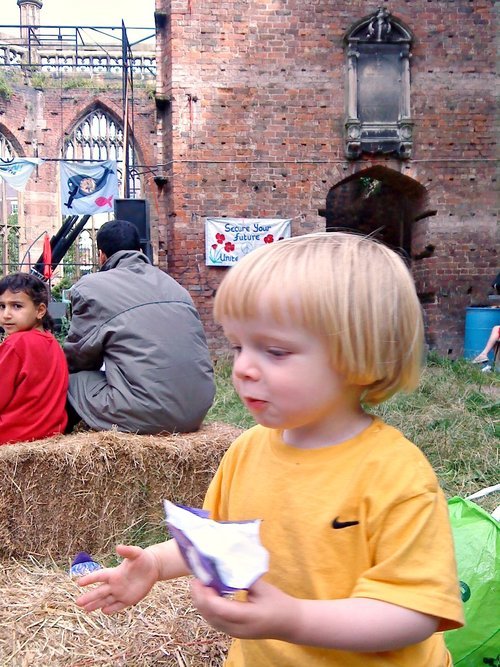
That was the first of many events I’d attend in this wonderful setting.
One of my favourite ever events there was going to see a really old black and white film of Carols from Kings, on the winter solstice of 2011, with my then-pretty-new boyfriend. We sat on bails of hay and watched the film with its candles, songs, and yawning choirboys, and were astounded at how warm it was for that time of year.
There is something of a festival vibe to any event in St. Luke’s, but beyond the fact of listening to music - or whatever it is you’re doing - in an outdoor setting. It’s about the way that you can connect with people there in a way that just a few meters away, outside, you can’t. Of course, we chat to strangers in ‘bus stops and in shops and exchange pleasantries about the weather, but in St. Luke’s it feels almost like you’ve been transported into another realm. There you are, watching a performance of some kind, or getting involved in an activity, inside what’s essentially a cross between a church and a park, and yet you’re at the top of one of Liverpool’s busiest shopping streets… and yet again, you wouldn’t know it. You could be anywhere; you could be in San Francisco, Paris, Amsterdam or faeryland … or nowhere, a place removed from the universe itself, where time seems to slow down and prejudices seem to melt away. It’s magical.
I realise this sounds like hyperbole. No such thing as magic, is there? Get this though; not long after my divorce had finally come through I said to my bezzie mate, “nah, I’ll never get married again. Unless I can do it in the Bombed Out Church,” as a kind of a joke. Well, remember the chap I mentioned a few paragraphs ago? This September, we’re marrying each other, in the Bombed Out Church.
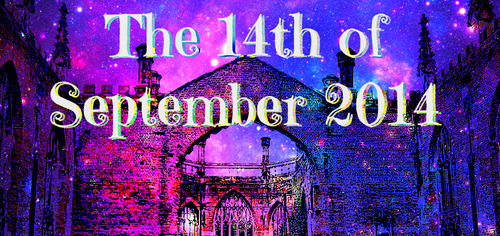
That same boyfriend is also my musical partner. We gig around town and in St. Helens (where we live) as Moss & Jones, performing folky originals and imaginative, fun covers. We started out in 2012 as a pair of carollers, and took it from there. It had long been our dream to gig in the Bombed Out Church, and early this year we contacted them, tentatively, to ask if it would be possible. Imagine our delight when we got a yes! The gig was arranged for the end of May, but between arranging it and the gig happening, we, like everyone else, heard the bad news that St. Luke’s was - well, no one seemed entirely sure what was happening, except that various people wanted to take this amazing place and either turn it into an hotel, a food hub or pave it over and install a Starbucks.
None of these things seemed to allow the possibility of gigs, events, concerts, films, yoga/tai chi/meditation and so on continuing. None of these things seemed to take into account the fact St. Luke’s is also a war memorial, and a lasting monument to those in Liverpool who lived through, or died in, the Blitz.
In the end, our gig went ahead, and we even got asked back for a second. We were incredibly privileged to be able to perform in this amazing setting not just once, but twice.
We’re hoping we’ll get asked back again at some point; maybe we could come back in the winter and do a full carol concert?
At the moment, Ambrose and his coterie of wonderful helpers keep the church open regularly, relying solely on donations from the public since the council’s funding has been cut. Given that people can access the church for as little as just a pound (not that there’s anything wrong with this; it’s lovely it’s so accessible and that’s part of its charm. In fact, I understand that on occasion the fee has been waived for people who genuinely cannot afford it, with payment made instead in the form of odd jobs, such as watering the plants), you can “do the math” and see that this state of affairs isn’t sustainable.
This is why they’ve set up a crowdfunding project. If they raise the money it will go towards the many repairs needed to keep the church going, and also towards helping keep the church open in bad weather, drawing in more people. In fact, considering the sheer amount of work that needs to be done, it’s impressive that they’ll manage to bring it in for £18,000, the amount they’re hoping to raise.
When the Bombed Out Church was first under threat, there was a petition to save it; it got over 30,000 signatures. If everyone who signed the petition put in just a quid they’d have smashed their target. But signing something is a lot easier than putting your hand in your pocket, it seems, and with just a few weeks to go, the Bombie is still quite some way off its target. I’m not entirely sure why this would be, but maybe people don’t realise that if they don’t meet their target, crowdfunder will give everyone their money back. What does this mean for the Bombed Out Church? Well, no more gigs. No more immersive theatre. No more Qi Gong. No more Blitz Exhibitions. No more handfastings or quirky wedding celebration. No more 96 Footballs. No more stepping off the street and entering what feels like another world.
Just another building. If you don’t want this for the Bombed Out Church than go and donate right away! The lovely thing about Crowdfunder is that you actually get a gift if you donate anything £2 or over, from a shout out on their Facebook page to a guided tour, and more (we’ve bought a brick). It’s a fairly simple process; if you’ve ever bought anything from the internet you’ll be comfortable donating online; you can use your card (no additional charge) or paypal (a small additional charge, but it saves them from incurring the charge, so that’s good).
And if you really honestly truly do not have £2 to spare, and there have been times in my life when that’s been the case, then get the word out. Blog about this, tweet about it {copy and paste this link: http://www.crowdfunder.co.uk/bombed-out-church}, put it on Facebook, reblog this tumblr post, get yourself on WhatsApp and send the link to all your mates, post something on snapchat… over and over again until people get the message; this place is unique, and YOU can be one of the people that saves it. Imagine being that person?
As a teenager though, when I started going into town by myself or with mates, I was either hanging around in or outside the School Lane Quiggins, or wandering up and down Bold Street, and so it was that I first wondered what that weird locked up church with no roof was at the top of Bold Street. Fast forward a few years to university (I stayed at home and went to Liverpool uni. Yet I still got a grant. The olden days, ay?) and me and a couple of friends managed to sneak into the gardens, though we couldn’t get into the mysterious building itself.
A few years later, after a stint in London followed by a return to Merseyside, the church was still locked up and looked pretty inaccessible. The steps, on the other hand, were a fantastic landmark to meet friends in the days where still not all of us had mobile phones, and those of us who did were forever running out of credit.
In fact, I didn’t go into the church itself until my son was a new baby, seven years ago. I didn’t realise it at the time, but it had been transformed by Ambrose Reynolds and Urban Strawberry Lunch, in an incredibly hands-on (like, cleaning human faeces out of the pond, getting rid of rats, clearing away needles, that kind of hands-on) way.
The first actual gig I attended there was a CND gig, back in 2009. I’d not long left my then-husband and I wanted to get out more. I think Tony Kehoe (who runs the Egg Café open mic) might have done a set, but I’m not sure because I was so busy running about after my little one to stop him exploring in the pond that I can’t remember much else!
That was the first of many events I’d attend in this wonderful setting.
One of my favourite ever events there was going to see a really old black and white film of Carols from Kings, on the winter solstice of 2011, with my then-pretty-new boyfriend. We sat on bails of hay and watched the film with its candles, songs, and yawning choirboys, and were astounded at how warm it was for that time of year.
There is something of a festival vibe to any event in St. Luke’s, but beyond the fact of listening to music - or whatever it is you’re doing - in an outdoor setting. It’s about the way that you can connect with people there in a way that just a few meters away, outside, you can’t. Of course, we chat to strangers in ‘bus stops and in shops and exchange pleasantries about the weather, but in St. Luke’s it feels almost like you’ve been transported into another realm. There you are, watching a performance of some kind, or getting involved in an activity, inside what’s essentially a cross between a church and a park, and yet you’re at the top of one of Liverpool’s busiest shopping streets… and yet again, you wouldn’t know it. You could be anywhere; you could be in San Francisco, Paris, Amsterdam or faeryland … or nowhere, a place removed from the universe itself, where time seems to slow down and prejudices seem to melt away. It’s magical.
I realise this sounds like hyperbole. No such thing as magic, is there? Get this though; not long after my divorce had finally come through I said to my bezzie mate, “nah, I’ll never get married again. Unless I can do it in the Bombed Out Church,” as a kind of a joke. Well, remember the chap I mentioned a few paragraphs ago? This September, we’re marrying each other, in the Bombed Out Church.
That same boyfriend is also my musical partner. We gig around town and in St. Helens (where we live) as Moss & Jones, performing folky originals and imaginative, fun covers. We started out in 2012 as a pair of carollers, and took it from there. It had long been our dream to gig in the Bombed Out Church, and early this year we contacted them, tentatively, to ask if it would be possible. Imagine our delight when we got a yes! The gig was arranged for the end of May, but between arranging it and the gig happening, we, like everyone else, heard the bad news that St. Luke’s was - well, no one seemed entirely sure what was happening, except that various people wanted to take this amazing place and either turn it into an hotel, a food hub or pave it over and install a Starbucks.
None of these things seemed to allow the possibility of gigs, events, concerts, films, yoga/tai chi/meditation and so on continuing. None of these things seemed to take into account the fact St. Luke’s is also a war memorial, and a lasting monument to those in Liverpool who lived through, or died in, the Blitz.
In the end, our gig went ahead, and we even got asked back for a second. We were incredibly privileged to be able to perform in this amazing setting not just once, but twice.
We’re hoping we’ll get asked back again at some point; maybe we could come back in the winter and do a full carol concert?
At the moment, Ambrose and his coterie of wonderful helpers keep the church open regularly, relying solely on donations from the public since the council’s funding has been cut. Given that people can access the church for as little as just a pound (not that there’s anything wrong with this; it’s lovely it’s so accessible and that’s part of its charm. In fact, I understand that on occasion the fee has been waived for people who genuinely cannot afford it, with payment made instead in the form of odd jobs, such as watering the plants), you can “do the math” and see that this state of affairs isn’t sustainable.
This is why they’ve set up a crowdfunding project. If they raise the money it will go towards the many repairs needed to keep the church going, and also towards helping keep the church open in bad weather, drawing in more people. In fact, considering the sheer amount of work that needs to be done, it’s impressive that they’ll manage to bring it in for £18,000, the amount they’re hoping to raise.
When the Bombed Out Church was first under threat, there was a petition to save it; it got over 30,000 signatures. If everyone who signed the petition put in just a quid they’d have smashed their target. But signing something is a lot easier than putting your hand in your pocket, it seems, and with just a few weeks to go, the Bombie is still quite some way off its target. I’m not entirely sure why this would be, but maybe people don’t realise that if they don’t meet their target, crowdfunder will give everyone their money back. What does this mean for the Bombed Out Church? Well, no more gigs. No more immersive theatre. No more Qi Gong. No more Blitz Exhibitions. No more handfastings or quirky wedding celebration. No more 96 Footballs. No more stepping off the street and entering what feels like another world.
Just another building. If you don’t want this for the Bombed Out Church than go and donate right away! The lovely thing about Crowdfunder is that you actually get a gift if you donate anything £2 or over, from a shout out on their Facebook page to a guided tour, and more (we’ve bought a brick). It’s a fairly simple process; if you’ve ever bought anything from the internet you’ll be comfortable donating online; you can use your card (no additional charge) or paypal (a small additional charge, but it saves them from incurring the charge, so that’s good).
And if you really honestly truly do not have £2 to spare, and there have been times in my life when that’s been the case, then get the word out. Blog about this, tweet about it {copy and paste this link: http://www.crowdfunder.co.uk/bombed-out-church}, put it on Facebook, reblog this tumblr post, get yourself on WhatsApp and send the link to all your mates, post something on snapchat… over and over again until people get the message; this place is unique, and YOU can be one of the people that saves it. Imagine being that person?
Tuesday, 24 June 2014
Marc Needs To Talk About Glastonbury...
Marc writes:
Ah, the last Wednesday in June. Round about now on this day in many past years I’ve been orbiting the Bristol ringroad, looking for the right exit, or heading blindly towards Bridgewater, looking over every rise in the hill for tell-tale flags, or the reflection of sunshine on big tops.
[Oh God, he’s going to do a blog post about Glastonbury, isn’t he? At long last someone has the bravery to break the omerta that surrounds this little-discussed event.]
I first went to Glastonbury in 1994. I was eighteen and had spent weeks convincing my worried mother that it was just a big gathering of people enjoying music, in a beautiful natural setting. Nothing bad would happen. It was a totally safe environment.
Aside from a slight attack of nerves before we left (‘What do you DO at a festival?’), I had a wonderful time, heard, saw, felt, drank and tasted things I’d never done before and came back Slightly Changed (albeit cross at having slept through the Beastie Boys’ set). Being that type of teenager, I wrote a letter to the organisers that week, saying (with only slight exaggeration) that being at the festival was the first time I’d really enjoyed music again since my dad died the year before.
[Oh, it’s one of THOSE blog posts. If he’s going to try and be ‘deep’ I’m going to stop reading.]
After that first, startling, visit, I went back to Glastonbury as often as I could. At that time, when the festival wasn’t so much of a big thing, getting a ticket was pretty much just a matter of having the requisite money and knowing where Probe Records in Liverpool was. Some years were marvellous, some were pretty awful. However, a year didn’t go by when I didn’t, at some point, witness something truly magical while on Worthy Farm, whether it was a man jumping off the back of a moving double-decker ‘bus and walking away unharmed, the best live gig I have ever seen, a perplexing-yet-beautiful shrine to the Virgin Mary up by the stone circle or a hundred other things.
[Is he going to make a point here, or is this just going to be ‘This one time at Glastonbury…’?]
As the nineties ended and the following decade began, it became more of a struggle to get tickets for the festival, to the point where it was no longer a fixed point in my yearly calendar, but a thing to be cautiously hoped for and worried about.
[First. World. Problems.]
This increased demand for tickets was, I think, due to a number of things, the first of which was the BBC acquiring the rights to cover the festival on television. Glastonbury had been televised since the year I’d first attended (1994), but by Channel Four in mostly late night slots. In 1997 the BBC took over the festival’s screening rights and since then has made more and more of its coverage.
This has had the effect that far more people have seen the festival on television and have some idea of what goes on there than before, and a fair proportion of them, quite naturally, decide they’d like to go.
[He’s going to tell us these people are somehow wrong now, isn’t he? I bet he is.]
There’s an argument which says that because the BBC mostly covers a certain side of what is in reality a vast performing arts festival, ie big bands playing on big stages, that there are more people now who think that’s what Glastonbury is all about and who get there and set up in front of the main stage for three days, ignoring the thousands of other things there are to do on site.
This is an argument I’d agree with to some extent, although there have always been people who were just there for the big bands, and good luck to them. If people come along to modern day Glastonbury unaware that you can also spend the weekend, say, listening to poetry, watching theatre, or learning stone-carving, then that’s the fault of the broadcaster for not including these elements in its coverage.
[Oh, don’t be ridiculous. The BBC has paid a fortune to cover this event, and devotes prime-time slots to it. What are they going to show: Elbow on the Pyramid Stage or Woody Bop Muddy’s Record Graveyard in the Cabaret Tent?]
As a consequence of the BBC going so big on Glastonbury, the past decade or so has also seen a new phenomenon: The Festivalisation of English Public Life. Glastonbury receiving widespread coverage on the BBC has made it a part of the nebulous ‘national calendar’ in the same way that Wimbledon and the Last Night of the Proms are. It’s no longer thought of as hippies and oddballs in a field, only making the news when someone gets shot.
This has led, as we’ve seen, to vastly increased demand for tickets, but also to a mushrooming in the number of festivals during each summer. Writing in 2014, Peak Festival may just have passed, with a number of big events either cancelling or downsizing in the past year or so, but there are still hugely more festivals taking place every summer than there were ten or so years ago. And to look at them, with their flags and bunting and spoken-word stages, it’s not Reading or T in the Park they’re aping.
This spread of festivals has now gone so far as to move into things that aren’t even festivals. What would, five years ago, have been a recruitment fair is now a Recruitment Festival and what were farmers’ markets are now food festivals. Ukuleles on advert soundtracks and the winsome nonsense on the back of Innocent smoothie bottles: this all, ultimately, comes from Glastonbury or, more accurately, the BBC’s version of Glastonbury.
[‘Not like it was in my day’. Boo-hoo, Gramps. I bet he’s going to tell us it ‘lost its soul’ when they stopped letting people jump the fence.]
Actually, no. Fence jumping seemed to have been tacitly allowed when the number of people doing it was manageable. In the aftermath of 2000, when as many people bunked in as paid for tickets, doubling the number of people on site and making for some genuinely dangerous crushes, the organisers had to do something, or the festival couldn’t have continued. Since that year, they’ve substantially increased the camping capacity, allowing many more people to attend than would have been able to pre-2000.
Unlike some people who started going to Glastonbury before it was BBC-massive, I don’t think the festival has changed all that much, and many of the ways in which it has changed have been for the better; site drainage is greatly improved, meaning that no matter how much it rains, there’ll be no repeat of the ‘sloshing round, shin-deep in liquid mud’ delights of the late nineties, there’s more stuff going on ‘after hours’, in an area of the site where there are no close neighbours to be bothered by noise, and there are more performance areas, filled with stuff you wouldn’t find at any other big festival.
The only thing which has really changed is the number of people who want to go, and the concomitant decreased likelihood of getting a ticket.
[See? He’s just bitter! All this ‘Festivalisation of English Pubic Lice’ or whatever is just covering up the fact that he’s pissed off he didn’t get a ticket.]
That’s true for some years, but not this one (see below). I’ve been trying to think of an analogy for this situation, and the closest one I can think of is Doctor Who-related.
[You don’t say.]
I feel a bit like full-on classic series Doctor Who fans must have felt in 2005. The thing I loved when it was a minority interest is now really popular and lots of other people love it, although perhaps not for the same reasons as I do. Actually, for this analogy to really hold, the BBC would have to give out a limited number of TV licences per year and if you didn’t secure one you couldn’t watch Doctor Who. Perhaps it’s more like having a long-time favourite restaurant which suddenly becomes wildly popular and you can’t get a table any more.
[‘…and the new people like that thing you like but in the WRONG WAY and they shouldn’t be ALLOWED to like it!!1]
While I’ve been cheesed off in previous years at not getting a ticket for my favourite festival, I’ve tried not to get bitter towards people who do get to go. Why shouldn’t someone who’s seen Glastonbury on the telly get to have the same life-changing
[Did he just say ‘life-changing’? I think he actually did, you know.]
…experience as I did? Perhaps if more people were lucky enough to have three days of beautiful surroundings and wonderful, imaginative performances and being able to pretty much please themselves, the country would be a happier place. Perhaps the tickets that I’ve missed out on in previous years have gone to the 2010’s eighteen year old equivalent of me, who’ll get so much more out of being there for his first time than thirty eight year old me, there for his umpteenth.
[So what are you saying? That we should round up people and MAKE them go to Glastonbury? Should there be ‘out-reach’ to help young people who can’t afford the tickets to go? You really haven’t thought this through at ALL, have you?]
Perhaps this is something I should try to achieve: to try harder to put the values I associate with the festival (tolerance, freedom of expression, the power of art to effect change) and my experience of it, into my daily life and my interactions with other people.
So there we are: I love going to Glastonbury but I’ve not been since 2010. Since then, one year the festival wasn’t on, and the other times I didn’t get a ticket. This year, however, I’m not going for a different reason; I didn’t even try to buy a ticket.
There had been talk last year (and the one before, I think) about me, Ruth and Cherub going to Glastonbury together. We’d done Ye Olde Traditional Broadbande Competition two Octobers running, to no avail. Last summer I went with my brother to Boomtown Fair, (a pretty good festival run by people who used to be involved with Glastonbury. Although it’s for a younger, slightly more drug-orientated crowd than me, its heart’s in the right place and the two times I’ve been there so far have been good fun. I’ll be going back this August, in fact) and with Ruth and Cherub to the Just-So Festival (which Ruth wrote a lovely account of here).
During the weekend at the Just-So, as we enjoyed the various activities on offer, it became clear to me that this was a rather different experience to Glastonbury, in terms of size if nothing else. The comparison made me think about the wisdom of taking a six or seven year old to somewhere like Glastonbury, and brought back the memory that most of the children of that age I’d seen there over the years had looked either exhausted, miserable or both.
So Ruth and I decided not to even attempt to go to Glastonbury this year, a decision aided by the local education authority’s utterly insane attitude to children being taken out of school in term time. We’ll have another wonderful time at the Just-So in August.
So, how will we be entertaining ourselves this weekend, and avoiding ‘#Glasto’ tweets and witless ‘How Glastonbury lost its soul and went middle class’ newspaper features? By hosting our own outdoor event, of course! We’ll be playing some wonderful music in a beautiful setting and hoping to create a bit of magic. Sounds familiar…
Ah, the last Wednesday in June. Round about now on this day in many past years I’ve been orbiting the Bristol ringroad, looking for the right exit, or heading blindly towards Bridgewater, looking over every rise in the hill for tell-tale flags, or the reflection of sunshine on big tops.
[Oh God, he’s going to do a blog post about Glastonbury, isn’t he? At long last someone has the bravery to break the omerta that surrounds this little-discussed event.]
I first went to Glastonbury in 1994. I was eighteen and had spent weeks convincing my worried mother that it was just a big gathering of people enjoying music, in a beautiful natural setting. Nothing bad would happen. It was a totally safe environment.
Aside from a slight attack of nerves before we left (‘What do you DO at a festival?’), I had a wonderful time, heard, saw, felt, drank and tasted things I’d never done before and came back Slightly Changed (albeit cross at having slept through the Beastie Boys’ set). Being that type of teenager, I wrote a letter to the organisers that week, saying (with only slight exaggeration) that being at the festival was the first time I’d really enjoyed music again since my dad died the year before.
[Oh, it’s one of THOSE blog posts. If he’s going to try and be ‘deep’ I’m going to stop reading.]
After that first, startling, visit, I went back to Glastonbury as often as I could. At that time, when the festival wasn’t so much of a big thing, getting a ticket was pretty much just a matter of having the requisite money and knowing where Probe Records in Liverpool was. Some years were marvellous, some were pretty awful. However, a year didn’t go by when I didn’t, at some point, witness something truly magical while on Worthy Farm, whether it was a man jumping off the back of a moving double-decker ‘bus and walking away unharmed, the best live gig I have ever seen, a perplexing-yet-beautiful shrine to the Virgin Mary up by the stone circle or a hundred other things.
[Is he going to make a point here, or is this just going to be ‘This one time at Glastonbury…’?]
As the nineties ended and the following decade began, it became more of a struggle to get tickets for the festival, to the point where it was no longer a fixed point in my yearly calendar, but a thing to be cautiously hoped for and worried about.
[First. World. Problems.]
This increased demand for tickets was, I think, due to a number of things, the first of which was the BBC acquiring the rights to cover the festival on television. Glastonbury had been televised since the year I’d first attended (1994), but by Channel Four in mostly late night slots. In 1997 the BBC took over the festival’s screening rights and since then has made more and more of its coverage.
This has had the effect that far more people have seen the festival on television and have some idea of what goes on there than before, and a fair proportion of them, quite naturally, decide they’d like to go.
[He’s going to tell us these people are somehow wrong now, isn’t he? I bet he is.]
There’s an argument which says that because the BBC mostly covers a certain side of what is in reality a vast performing arts festival, ie big bands playing on big stages, that there are more people now who think that’s what Glastonbury is all about and who get there and set up in front of the main stage for three days, ignoring the thousands of other things there are to do on site.
This is an argument I’d agree with to some extent, although there have always been people who were just there for the big bands, and good luck to them. If people come along to modern day Glastonbury unaware that you can also spend the weekend, say, listening to poetry, watching theatre, or learning stone-carving, then that’s the fault of the broadcaster for not including these elements in its coverage.
[Oh, don’t be ridiculous. The BBC has paid a fortune to cover this event, and devotes prime-time slots to it. What are they going to show: Elbow on the Pyramid Stage or Woody Bop Muddy’s Record Graveyard in the Cabaret Tent?]
As a consequence of the BBC going so big on Glastonbury, the past decade or so has also seen a new phenomenon: The Festivalisation of English Public Life. Glastonbury receiving widespread coverage on the BBC has made it a part of the nebulous ‘national calendar’ in the same way that Wimbledon and the Last Night of the Proms are. It’s no longer thought of as hippies and oddballs in a field, only making the news when someone gets shot.
This has led, as we’ve seen, to vastly increased demand for tickets, but also to a mushrooming in the number of festivals during each summer. Writing in 2014, Peak Festival may just have passed, with a number of big events either cancelling or downsizing in the past year or so, but there are still hugely more festivals taking place every summer than there were ten or so years ago. And to look at them, with their flags and bunting and spoken-word stages, it’s not Reading or T in the Park they’re aping.
This spread of festivals has now gone so far as to move into things that aren’t even festivals. What would, five years ago, have been a recruitment fair is now a Recruitment Festival and what were farmers’ markets are now food festivals. Ukuleles on advert soundtracks and the winsome nonsense on the back of Innocent smoothie bottles: this all, ultimately, comes from Glastonbury or, more accurately, the BBC’s version of Glastonbury.
[‘Not like it was in my day’. Boo-hoo, Gramps. I bet he’s going to tell us it ‘lost its soul’ when they stopped letting people jump the fence.]
Actually, no. Fence jumping seemed to have been tacitly allowed when the number of people doing it was manageable. In the aftermath of 2000, when as many people bunked in as paid for tickets, doubling the number of people on site and making for some genuinely dangerous crushes, the organisers had to do something, or the festival couldn’t have continued. Since that year, they’ve substantially increased the camping capacity, allowing many more people to attend than would have been able to pre-2000.
Unlike some people who started going to Glastonbury before it was BBC-massive, I don’t think the festival has changed all that much, and many of the ways in which it has changed have been for the better; site drainage is greatly improved, meaning that no matter how much it rains, there’ll be no repeat of the ‘sloshing round, shin-deep in liquid mud’ delights of the late nineties, there’s more stuff going on ‘after hours’, in an area of the site where there are no close neighbours to be bothered by noise, and there are more performance areas, filled with stuff you wouldn’t find at any other big festival.
The only thing which has really changed is the number of people who want to go, and the concomitant decreased likelihood of getting a ticket.
[See? He’s just bitter! All this ‘Festivalisation of English Pubic Lice’ or whatever is just covering up the fact that he’s pissed off he didn’t get a ticket.]
That’s true for some years, but not this one (see below). I’ve been trying to think of an analogy for this situation, and the closest one I can think of is Doctor Who-related.
[You don’t say.]
I feel a bit like full-on classic series Doctor Who fans must have felt in 2005. The thing I loved when it was a minority interest is now really popular and lots of other people love it, although perhaps not for the same reasons as I do. Actually, for this analogy to really hold, the BBC would have to give out a limited number of TV licences per year and if you didn’t secure one you couldn’t watch Doctor Who. Perhaps it’s more like having a long-time favourite restaurant which suddenly becomes wildly popular and you can’t get a table any more.
[‘…and the new people like that thing you like but in the WRONG WAY and they shouldn’t be ALLOWED to like it!!1]
While I’ve been cheesed off in previous years at not getting a ticket for my favourite festival, I’ve tried not to get bitter towards people who do get to go. Why shouldn’t someone who’s seen Glastonbury on the telly get to have the same life-changing
[Did he just say ‘life-changing’? I think he actually did, you know.]
…experience as I did? Perhaps if more people were lucky enough to have three days of beautiful surroundings and wonderful, imaginative performances and being able to pretty much please themselves, the country would be a happier place. Perhaps the tickets that I’ve missed out on in previous years have gone to the 2010’s eighteen year old equivalent of me, who’ll get so much more out of being there for his first time than thirty eight year old me, there for his umpteenth.
[So what are you saying? That we should round up people and MAKE them go to Glastonbury? Should there be ‘out-reach’ to help young people who can’t afford the tickets to go? You really haven’t thought this through at ALL, have you?]
Perhaps this is something I should try to achieve: to try harder to put the values I associate with the festival (tolerance, freedom of expression, the power of art to effect change) and my experience of it, into my daily life and my interactions with other people.
So there we are: I love going to Glastonbury but I’ve not been since 2010. Since then, one year the festival wasn’t on, and the other times I didn’t get a ticket. This year, however, I’m not going for a different reason; I didn’t even try to buy a ticket.
There had been talk last year (and the one before, I think) about me, Ruth and Cherub going to Glastonbury together. We’d done Ye Olde Traditional Broadbande Competition two Octobers running, to no avail. Last summer I went with my brother to Boomtown Fair, (a pretty good festival run by people who used to be involved with Glastonbury. Although it’s for a younger, slightly more drug-orientated crowd than me, its heart’s in the right place and the two times I’ve been there so far have been good fun. I’ll be going back this August, in fact) and with Ruth and Cherub to the Just-So Festival (which Ruth wrote a lovely account of here).
During the weekend at the Just-So, as we enjoyed the various activities on offer, it became clear to me that this was a rather different experience to Glastonbury, in terms of size if nothing else. The comparison made me think about the wisdom of taking a six or seven year old to somewhere like Glastonbury, and brought back the memory that most of the children of that age I’d seen there over the years had looked either exhausted, miserable or both.
So Ruth and I decided not to even attempt to go to Glastonbury this year, a decision aided by the local education authority’s utterly insane attitude to children being taken out of school in term time. We’ll have another wonderful time at the Just-So in August.
So, how will we be entertaining ourselves this weekend, and avoiding ‘#Glasto’ tweets and witless ‘How Glastonbury lost its soul and went middle class’ newspaper features? By hosting our own outdoor event, of course! We’ll be playing some wonderful music in a beautiful setting and hoping to create a bit of magic. Sounds familiar…
Monday, 16 December 2013
Making Christmas bearable
Ruth writes:
Ah, Christmas. A time for giving, a time for receiving, the time when every Santa has a ball.
Except, being serious for half a minute, it’s not always great for everyone. At least Mud acknowledged this, but listening to most Christmas songs you’d think Christmas was a laugh-a-minute affair, celebrated by everyone in the UK (if not the world) which every extended family spent together, living, as they do, all on the same street, possibly all in the same house, having an absolutely wonderful time.
But no. There are many people who find Christmas hard going.
Some people don’t celebrate it at all, and it must feel a bit weird and frankly a tad off-pissing to walk the aisles of supermarkets decked with CHRISTMAS CHRISTMAS CHRISTMAS CHRISTMAS in bright red and green fonts if it’s not your celebration.
Here in the UK, although only about 60% of the population considers itself Christian enough to put it on a census, Christmas is ubiquitous; so much so that church campaigns focus on remembering the “true meaning” of Christmas out of fears it has become too secular. Basically, if you’re not excited about celebrating Christmas you can feel like a bit of a weirdo.
There’s a fantastic article on coping with Christmas over at The F Word, which I’d recommend everyone to go and read.
I just wanted to add my two-pence worth about an issue close to my heart: not being able to celebrate on Christmas day itself.
If you love the idea of Christmas, but for whatever reason (you have to work, or perhaps your child or children are at their other parent’s for much of or even the whole the day, other family members or friends not living nearby and so on) there’s nothing wrong with having your Christmas celebration on another day. It doesn’t have to be on the day itself. You could opt for giving presents on St. Nicholas’ Eve/Day (though without some of the other traditions associated with gift giving then), or perhaps celebrating the winter solstice, instead. Boxing day might be good too; a more relaxing celebration with turkey butties and less pressure.
Making a big, special deal of the day or days when you can all be together, rather than being miserable on the day that you can’t, is a good option. It seems slightly silly, in fact, to try and limit Christmas to one day in a year. If you were organising a meeting, you’d give delegates a range of dates and choose the one where most people were available. You might even put on more than one meeting if there were quite a few delegates. You wouldn’t tell them there was one day, and only one day, when the meeting could be held and if they didn’t attend, it somehow made them in the wrong. Why is Christmas somehow different, just because supermarkets, television and TRADITION tells us there is only ONE day?
And of course, if you do the whole “Father Christmas” thing, it makes more sense that he spreads his workload out over a few days, rather than trying to get it all done at once. You could even tell your child/ren that FC makes an extra special trip, just for them, because they’re having Christmas on a different day (if, like me, you feel uncomfortable about telling an out-and-out lie to your child/ren, there’s some pretty good advice here on how to give them the best of both worlds when it comes to Father Christmas).
And if you are celebrating Christmas, whatever day you celebrate it on, have a look at our free (or pay what you want) collection of Christmassy songs. We promise some of them are a bit miserable.
Ah, Christmas. A time for giving, a time for receiving, the time when every Santa has a ball.
Except, being serious for half a minute, it’s not always great for everyone. At least Mud acknowledged this, but listening to most Christmas songs you’d think Christmas was a laugh-a-minute affair, celebrated by everyone in the UK (if not the world) which every extended family spent together, living, as they do, all on the same street, possibly all in the same house, having an absolutely wonderful time.
But no. There are many people who find Christmas hard going.
Some people don’t celebrate it at all, and it must feel a bit weird and frankly a tad off-pissing to walk the aisles of supermarkets decked with CHRISTMAS CHRISTMAS CHRISTMAS CHRISTMAS in bright red and green fonts if it’s not your celebration.
Here in the UK, although only about 60% of the population considers itself Christian enough to put it on a census, Christmas is ubiquitous; so much so that church campaigns focus on remembering the “true meaning” of Christmas out of fears it has become too secular. Basically, if you’re not excited about celebrating Christmas you can feel like a bit of a weirdo.
There’s a fantastic article on coping with Christmas over at The F Word, which I’d recommend everyone to go and read.
I just wanted to add my two-pence worth about an issue close to my heart: not being able to celebrate on Christmas day itself.
If you love the idea of Christmas, but for whatever reason (you have to work, or perhaps your child or children are at their other parent’s for much of or even the whole the day, other family members or friends not living nearby and so on) there’s nothing wrong with having your Christmas celebration on another day. It doesn’t have to be on the day itself. You could opt for giving presents on St. Nicholas’ Eve/Day (though without some of the other traditions associated with gift giving then), or perhaps celebrating the winter solstice, instead. Boxing day might be good too; a more relaxing celebration with turkey butties and less pressure.
Making a big, special deal of the day or days when you can all be together, rather than being miserable on the day that you can’t, is a good option. It seems slightly silly, in fact, to try and limit Christmas to one day in a year. If you were organising a meeting, you’d give delegates a range of dates and choose the one where most people were available. You might even put on more than one meeting if there were quite a few delegates. You wouldn’t tell them there was one day, and only one day, when the meeting could be held and if they didn’t attend, it somehow made them in the wrong. Why is Christmas somehow different, just because supermarkets, television and TRADITION tells us there is only ONE day?
And of course, if you do the whole “Father Christmas” thing, it makes more sense that he spreads his workload out over a few days, rather than trying to get it all done at once. You could even tell your child/ren that FC makes an extra special trip, just for them, because they’re having Christmas on a different day (if, like me, you feel uncomfortable about telling an out-and-out lie to your child/ren, there’s some pretty good advice here on how to give them the best of both worlds when it comes to Father Christmas).
And if you are celebrating Christmas, whatever day you celebrate it on, have a look at our free (or pay what you want) collection of Christmassy songs. We promise some of them are a bit miserable.
Subscribe to:
Posts (Atom)